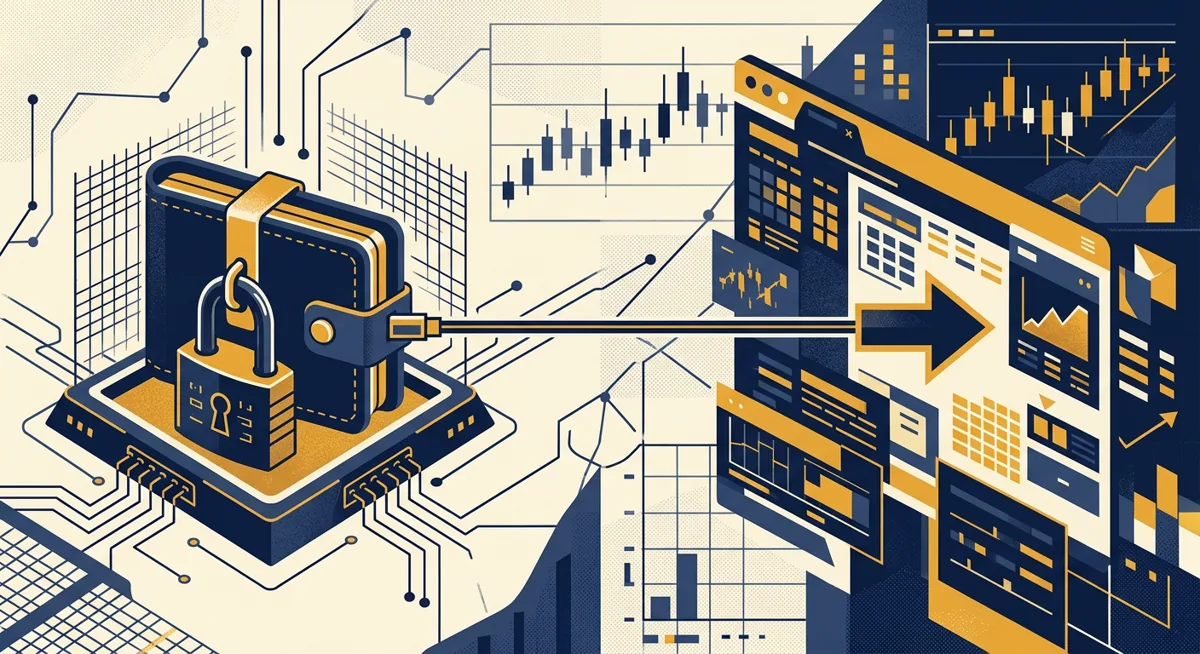
Verdict: an exchange account gives you a claim on crypto that Binance controls, while a cold wallet gives you the crypto itself, controlled by whoever holds the keys. Read on if you're deciding whether to leave funds on an exchange or move them into self-custody and you want the actual mechanics, not a slogan about ownership.
In short
- Exchange custody means Binance controls the private keys; self-custody means you do, through a cold wallet that keeps keys offline.
- Moving funds off an exchange requires a correctly whitelisted address, the right network selection, and patience for review delays.
- Trading fees like the spot maker fee of 0.100% and taker fee of 0.100% don't apply to on-chain withdrawals; instant buy purchases cost up to up to around 2% instead.
- Minimum deposit amounts vary by currency and method on Binance, so check the specific figure before sending a test transaction.
- Binance blocks access from a long list of countries, so custody choices can be moot if the exchange itself isn't available where you live.
Key facts
| Binance | |
|---|---|
| Fees | Spot maker fee (base tier): 0.100% Spot taker fee (base tier): 0.100% Instant buy / card purchase fee: up to around 2% |
| Limits | Minimum deposit: Minimum deposit amounts vary by currency and method |
| Deposit methods | — |
| Country availability | Restricted countries: American Samoa, Canada, Cuba, Cyprus, Guam, Indonesia, India, Iran, Japan, North Korea, Northern Mariana Islands, Philippines, Puerto Rico, Russia, Singapore, Thailand, Ukraine (Crimea Region incl. Donetsk, Luhansk, Zaporizhzhia and Kherson as well as the Crimea Peninsula), United States Minor Outlying Islands, USA, Vietnam, Virgin Islands (U.S.), Malaysia, Netherlands, United Arab Emirates, United Kingdom. |
What you need before moving crypto to a cold wallet
Self-custody sounds simple until you're staring at a withdrawal screen with a blank address field. Get these sorted first, because fixing mistakes after a transaction is broadcast usually isn't possible.
- A verified Binance account. Identity checks gate withdrawal limits, and an unverified account often can't move meaningful amounts at all.
- A cold wallet that's already initialized, with the seed phrase written down on paper or metal, stored somewhere that isn't a phone photo or a cloud note.
- The receiving address copied directly from the wallet app or device screen, never retyped from memory.
- Clarity on which network the asset uses. The same coin can exist on more than one chain, and the exchange withdrawal screen and the wallet's receiving screen both need to agree on that network.
- Address whitelisting turned on if you use it, with any mandatory waiting period already cleared before you need the funds urgently.
- A small amount set aside for a test transfer, separate from the main balance you intend to move.
None of this is exotic. It's just the checklist that separates a boring transfer from a support ticket that never gets resolved because the funds went to a valid-looking address on the wrong chain.
One-line takeaway: get the address, the network, and a test transaction sorted before you touch the full balance.
Steps: withdrawing crypto from an exchange to a cold wallet
- Open the cold wallet and generate a receiving address for the specific asset you plan to move. Don't reuse an old address from a different asset or chain.
- Log into Binance, go to the withdrawal section, and select the matching asset.
- Paste the address into the withdrawal field, then check it character by character against what the wallet screen shows. Don't trust a partial match.
- Choose the network that matches the address format. If the wallet doesn't clearly state which network it expects, check the wallet's own documentation rather than guessing from the exchange's default option.
- Send a small test transfer first. Confirm it lands in the wallet, showing a spendable balance, before sending anything larger.
- Wait for network confirmations. This depends entirely on the blockchain being used, not on how fast Binance processes the request.
- Once the test transaction is confirmed, withdraw the remaining balance. Doing it in one or two transactions rather than many keeps network fee exposure down.
- Confirm the final balance inside the wallet's own interface, not just by looking at a block explorer, so you know the funds are actually usable from keys you control.
Expect the first withdrawal from any account to take longer than later ones. New addresses, larger amounts, and freshly enabled whitelisting all tend to trigger extra review on the exchange side.
One-line takeaway: test small, verify twice, then move the rest in as few transactions as makes sense.
Fees and limits that apply to a withdrawal
Trading fees and withdrawal fees are not the same thing, and it's worth keeping them separate when you're comparing exchanges or deciding when to move funds.
| Item | Figure | Applies to a wallet transfer? |
|---|---|---|
| Spot maker fee | 0.100% | No — this is a trading fee |
| Spot taker fee | 0.100% | No — this is a trading fee |
| Instant buy / card purchase fee | up to around up to around 2% | No — this is an acquisition fee, paid before you ever withdraw |
| Minimum deposit | Minimum deposit amounts vary by currency and method Minimum deposit amounts vary by currency and method | Relevant if you're funding the account, not withdrawing from it |
| Country availability | Binance is restricted in a list of countries American Samoa, Canada, Cuba, Cyprus, Guam, Indonesia, India, Iran, Japan, North Korea, Northern Mariana Islands, Philippines, Puerto Rico, Russia, Singapore, Thailand, Ukraine (Crimea Region incl. Donetsk, Luhansk, Zaporizhzhia and Kherson as well as the Crimea Peninsula), United States Minor Outlying Islands, USA, Vietnam, Virgin Islands (U.S.), Malaysia, Netherlands, United Arab Emirates, United Kingdom. | Determines whether you can use the exchange at all |
Withdrawal network fees themselves aren't a single fixed number — they move with the underlying blockchain's congestion and vary by asset, so there's no one figure to quote here. What that means practically: check the fee shown on the withdrawal confirmation screen before you submit, not some remembered figure from a previous transfer.
Limits work in two directions. On the low end, there's a minimum deposit that varies by currency and method, so a test transfer sized too small can simply fail to register. On the high end, withdrawal limits scale with account verification level, which is why an unverified account hitting a ceiling is often a verification problem rather than a policy against self-custody.
Country restrictions sit outside the fee conversation entirely but matter just as much. Binance lists a long set of restricted jurisdictions, including the USA, the UK, Canada, and others named in its terms. If you're in one of those places, the fee schedule is irrelevant because the account access itself is the constraint.
One-line takeaway: trading fees don't apply to a wallet transfer, but network fees, minimum amounts, and country restrictions all still can block you.
Troubleshooting withdrawals and cold wallet transfers
Most self-custody problems trace back to one of a handful of causes. Working through them in order usually finds the issue faster than opening a support ticket first.
- Withdrawal stuck in review. Large amounts, a newly added address, or a recent whitelist change can all trigger manual review. Waiting it out is often the only option; contacting support helps if it stalls past the stated processing window.
- Address rejected on submission. This is almost always a network mismatch — the address format doesn't match the chain selected. Re-check the wallet's receiving screen for the correct network label.
- Funds sent but not visible in the wallet. Check that you're viewing the correct account or derivation path inside the wallet app, and confirm the transaction on a block explorer using the transaction hash from the exchange. If the explorer shows it arrived but the wallet doesn't, it's a display or sync issue, not a lost transfer.
- Withdrawal blocked entirely. Check your account region against the restricted country list American Samoa, Canada, Cuba, Cyprus, Guam, Indonesia, India, Iran, Japan, North Korea, Northern Mariana Islands, Philippines, Puerto Rico, Russia, Singapore, Thailand, Ukraine (Crimea Region incl. Donetsk, Luhansk, Zaporizhzhia and Kherson as well as the Crimea Peninsula), United States Minor Outlying Islands, USA, Vietnam, Virgin Islands (U.S.), Malaysia, Netherlands, United Arab Emirates, United Kingdom.. Access can be cut off regardless of balance or verification level.
- Deposit not registering. Compare the amount sent against the minimum deposit threshold, which varies by currency and method Minimum deposit amounts vary by currency and method. Amounts below that minimum may not credit at all.
- Test transaction never arrives. Before assuming it's lost, check the network's typical confirmation time for that specific chain. Some networks are simply slower than others under load.
One-line takeaway: most stuck transfers come down to a network mismatch or a verification issue, not a broken wallet.
Questions
What's the actual difference between a cold wallet and an exchange wallet?
An exchange wallet is custodial: Binance holds the private keys and you hold a claim on the balance shown in your account. A cold wallet keeps the private keys offline, under your own control, so the crypto moves only when you sign a transaction yourself.
Is it better to keep crypto on Binance or move it to a cold wallet?
For crypto you're not actively trading, self-custody removes exchange counterparty risk. For crypto you're trading right now, it generally needs to sit on the exchange to be usable for that purpose.
How much does it cost to withdraw crypto from Binance to a cold wallet?
Can I use Binance from any country?
No. Binance restricts access from a defined list of countries American Samoa, Canada, Cuba, Cyprus, Guam, Indonesia, India, Iran, Japan, North Korea, Northern Mariana Islands, Philippines, Puerto Rico, Russia, Singapore, Thailand, Ukraine (Crimea Region incl. Donetsk, Luhansk, Zaporizhzhia and Kherson as well as the Crimea Peninsula), United States Minor Outlying Islands, USA, Vietnam, Virgin Islands (U.S.), Malaysia, Netherlands, United Arab Emirates, United Kingdom., and that access limitation applies regardless of what fees or limits would otherwise apply.
What happens if I send crypto on the wrong network?
Funds sent to an address on a network it doesn't support are usually unrecoverable. Always confirm the network shown by the cold wallet matches the network selected on the exchange withdrawal screen before submitting.
References
| # | Source | Reliability | Checked |
|---|---|---|---|
| 1 | binance.com — Spot maker fee (base tier) | Official source | 2026-09-16 |
| 2 | binance.com — Instant buy / card purchase fee | Official source | 2026-09-16 |
| 3 | binance.com — Minimum deposit | Official source | 2026-09-16 |
| 4 | binance.com — Restricted countries | Official source | 2026-09-16 |