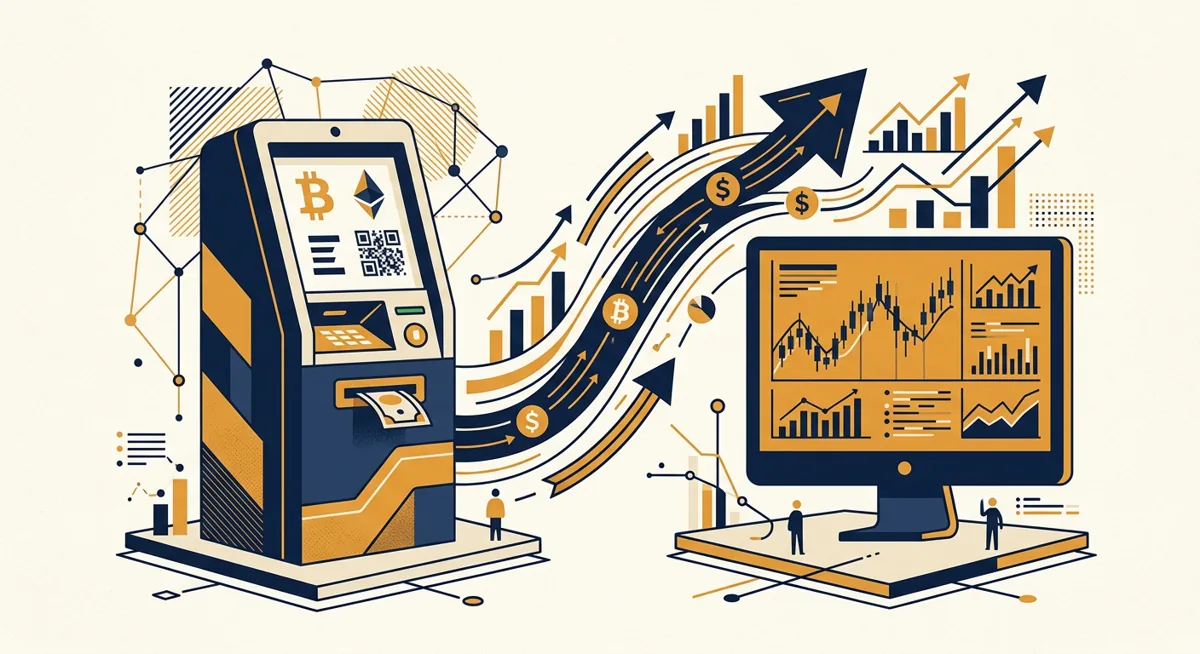
Centralized exchanges beat crypto ATMs on cost almost every time; ATMs win on speed and anonymity for small, urgent buys. This is for anyone typing "crypto atm near me" into a search bar before checking whether Binance, Coinbase, or Kraken would be cheaper for the same purchase.
In short
- Crypto ATM fees are built into the exchange rate spread and machine surcharge, not disclosed as a clean percentage the way exchange fees are.
- Binance's spot maker and taker fees sit at 0.100% and 0.100% at the base tier, far below typical ATM spreads.
- Binance's instant buy or card purchase fee runs up to around up to around 2%, which is the closer comparison point to an ATM transaction.
- Coinbase caps daily withdrawals at €100,000 per day, a limit that matters once you've bought crypto and want to move it out.
- Kraken accepts deposits as low as 1 USD and supports methods including Bank Transfer (ACH), SEPA (EUR, CAD), Fedwire, SWIFT, Etana Custody Wire Transfer, crypto deposits, phone digital wallet, credit or debit card.
Key facts
Selection criteria for this comparison
I picked these three exchanges because they're the ones readers actually ask about when comparing to a walk-up crypto ATM. The comparison rests on four things:
- Fee transparency. Can you find the number before you commit, or does it only show up as a worse exchange rate baked into the quote?
- Deposit and withdrawal limits. A cheap on-ramp is pointless if the daily cap forces you into multiple transactions.
- Deposit method variety. Bank transfer, card, or crypto-to-crypto — the more methods, the more likely one is free or near-free.
- Country availability. No fee comparison matters if the service is blocked in your jurisdiction.
Crypto ATMs get judged against the same four points, even though most machines fail the first one outright. There's no published fee schedule at most kiosks — you get a screen quote at the moment of the transaction, after the exchange rate has already been marked up.
One-line takeaway: fee transparency is the first filter, and it's also where ATMs consistently lose.
How Binance, Coinbase, and Kraken compare to a crypto ATM
Binance
Binance's spot trading fees are the cheapest lever in this comparison: maker fee 0.100% and taker fee 0.100% at the base tier. That's the rate you get once funds are already on the platform and you're trading, not depositing. The number that actually competes with an ATM is the instant buy or card purchase fee, which runs up to around up to around 2% — still generally lower than what a walk-up machine charges once you add the spread.
Minimum deposit amounts vary by currency and method (Minimum deposit amounts vary by currency and method), so there's no single figure to quote, which is itself a minor transparency gap compared to Kraken's flat minimum. Binance is not available everywhere — the restricted list includes American Samoa, Canada, Cuba, Cyprus, Guam, Indonesia, India, Iran, Japan, North Korea, Northern Mariana Islands, Philippines, Puerto Rico, Russia, Singapore, Thailand, Ukraine (Crimea Region incl. Donetsk, Luhansk, Zaporizhzhia and Kherson as well as the Crimea Peninsula), United States Minor Outlying Islands, USA, Vietnam, Virgin Islands (U.S.), Malaysia, Netherlands, United Arab Emirates, United Kingdom. — so check jurisdiction before assuming it's an option at all.
Coinbase
Coinbase's headline number in this data set is the withdrawal side, not the deposit side: a daily withdrawal limit of €100,000 per day. That's a high ceiling for most individual users, and it matters more once you've bought crypto through the exchange and want to move it to a wallet or another platform. An ATM has no equivalent published limit structure — machine operators set per-transaction and daily caps at their own discretion, and those caps are typically far below anything an exchange offers.
Kraken
Kraken's minimum deposit is 1 USD, which is about as low a barrier to entry as you'll find among centralized exchanges. Deposit methods span Bank Transfer (ACH), SEPA (EUR, CAD), Fedwire, SWIFT, Etana Custody Wire Transfer, crypto deposits, phone digital wallet, credit or debit card — a wider spread than most ATMs, which are cash-only by design. Kraken also publishes a clear restricted list: Prohibited regions: Afghanistan; Belarus; Crimea, Donetsk, and Luhansk regions of Ukraine; Cuba; Democratic Republic of the Congo; Iran; Iraq; Japan; Libya; North Korea; Russia; Sudan; South Sudan; Syria. That clarity is the point. You know before you start whether the service works for you, which is not something most ATM operators disclose upfront either.
Comparison table
| Platform | Base trading fee | Card/instant buy fee | Minimum deposit | Notable limit |
|---|---|---|---|---|
| Binance | Maker 0.100% / Taker 0.100% | Up to around up to around 2% | Varies by currency/method (Minimum deposit amounts vary by currency and method) | — |
| Coinbase | Not in this data set | Not in this data set | Not in this data set | Daily withdrawal €100,000 per day |
| Kraken | Not in this data set | Not in this data set | 1 USD | — |
| Crypto ATM | No published rate; spread-based | Spread-based, disclosed only at the kiosk | Varies by operator | Varies by operator, generally low |
One-line takeaway: exchanges publish numbers you can check in advance; ATMs give you a number only after you've fed in cash.
How to decide between a crypto ATM and an exchange
Start with what you're optimizing for, because the answer changes depending on the priority.
If cost is the priority: go with a centralized exchange. Binance's base spot fees (0.100% / 0.100%) and even its instant buy fee (up to around up to around 2%) are disclosed rates you can calculate against before you commit. A crypto ATM's cost is a spread hidden in the quoted rate, and that spread is not published anywhere for comparison — you find out at the machine.
If speed and anonymity are the priority: an ATM still has a case. No account creation, no identity verification tier to climb, cash in and crypto out in minutes. That convenience is real. It's just not free, and the fee data in this article can't quantify exactly how much you're paying because ATM operators don't publish it the way exchanges do.
If you're moving larger amounts: limits become the deciding factor. Coinbase's daily withdrawal limit of €100,000 per day is generous enough that most individual users won't hit it in normal use. ATM daily limits are typically set far lower per machine, which means multiple visits, multiple fees, and more exposure to that undisclosed spread each time.
If deposit method flexibility matters: Kraken's method list — Bank Transfer (ACH), SEPA (EUR, CAD), Fedwire, SWIFT, Etana Custody Wire Transfer, crypto deposits, phone digital wallet, credit or debit card — covers most common routes, and its minimum deposit of 1 USD is low enough to test the platform without committing much. Binance's minimum varies by currency and method (Minimum deposit amounts vary by currency and method), which means you need to check the specific pair you're funding before assuming a low floor.
If jurisdiction is a constraint: check the restricted lists before anything else. Binance blocks American Samoa, Canada, Cuba, Cyprus, Guam, Indonesia, India, Iran, Japan, North Korea, Northern Mariana Islands, Philippines, Puerto Rico, Russia, Singapore, Thailand, Ukraine (Crimea Region incl. Donetsk, Luhansk, Zaporizhzhia and Kherson as well as the Crimea Peninsula), United States Minor Outlying Islands, USA, Vietnam, Virgin Islands (U.S.), Malaysia, Netherlands, United Arab Emirates, United Kingdom.. Kraken blocks Prohibited regions: Afghanistan; Belarus; Crimea, Donetsk, and Luhansk regions of Ukraine; Cuba; Democratic Republic of the Congo; Iran; Iraq; Japan; Libya; North Korea; Russia; Sudan; South Sudan; Syria. An ATM's availability is a matter of physical location and operator licensing, which is a different kind of restriction but no less absolute — no machine, no transaction, regardless of fees.
Quick decision list
- Calculate the exchange's disclosed fee for your transaction size using the numbers above.
- Confirm your country isn't on the relevant restricted list.
- Check the deposit method you actually have available — bank transfer, card, or crypto.
- Only default to an ATM if speed outweighs the unknown spread cost, or if you have no other on-ramp in reach.
One-line takeaway: exchanges win on disclosed cost and limits; ATMs win only when immediacy is worth an unpriced premium.
Questions
Are crypto ATM fees higher than exchange fees?
Based on the fee structures shown here, exchange fees are disclosed as flat percentages — Binance's base maker and taker fees are 0.100% and 0.100% — while ATM costs are built into the exchange rate spread and not published as a comparable number. In practice that spread tends to run higher than exchange trading fees, but it isn't quoted the same way, so a direct percentage comparison isn't possible from published data alone.
What's the minimum I can deposit on an exchange versus an ATM?
Kraken's minimum deposit is 1 USD. Binance's minimum varies by currency and method (Minimum deposit amounts vary by currency and method). ATM minimums are set by the individual machine operator and aren't standardized, so there's no single figure to compare against.
Which exchange has the highest withdrawal limit in this comparison?
Coinbase's daily withdrawal limit is €100,000 per day, which is the only withdrawal figure available in this data set.
Can I use Binance or Kraken from any country?
No. Binance restricts American Samoa, Canada, Cuba, Cyprus, Guam, Indonesia, India, Iran, Japan, North Korea, Northern Mariana Islands, Philippines, Puerto Rico, Russia, Singapore, Thailand, Ukraine (Crimea Region incl. Donetsk, Luhansk, Zaporizhzhia and Kherson as well as the Crimea Peninsula), United States Minor Outlying Islands, USA, Vietnam, Virgin Islands (U.S.), Malaysia, Netherlands, United Arab Emirates, United Kingdom.. Kraken restricts Prohibited regions: Afghanistan; Belarus; Crimea, Donetsk, and Luhansk regions of Ukraine; Cuba; Democratic Republic of the Congo; Iran; Iraq; Japan; Libya; North Korea; Russia; Sudan; South Sudan; Syria. Check the current list for your country before assuming either platform is available.
Is a card purchase on an exchange cheaper than a crypto ATM?
Binance's instant buy or card purchase fee runs up to around up to around 2%. Crypto ATMs don't publish an equivalent fixed rate, so the honest answer is that the exchange number is disclosed and the ATM number generally isn't, which makes the exchange the easier one to budget for in advance.
References
| # | Source | Reliability | Checked |
|---|---|---|---|
| 1 | binance.com — Spot maker fee (base tier) | Official source | 2026-09-16 |
| 2 | binance.com — Instant buy / card purchase fee | Official source | 2026-09-16 |
| 3 | binance.com — Minimum deposit | Official source | 2026-09-16 |
| 4 | help.coinbase.com — Daily withdrawal limit | Official source | 2026-09-18 |
| 5 | support.kraken.com — Minimum deposit | Official source | 2026-09-18 |
| 6 | kraken.com — Deposit methods | Official source | 2026-09-18 |
| 7 | binance.com — Restricted countries | Official source | 2026-09-16 |
| 8 | support.kraken.com — Restricted countries | Official source | 2026-09-18 |