Conclusion: OKX’s attempt to enter the tokenized stock market has faced resistance from the companies whose stocks the platform sought to convert into tradable tokens. Read this article if you have accounts on OKX, trade equity-linked tokens on any exchange, or are a U.S. trader trying to understand what OKX actually offers you.
In short
- According to the news story underlying this article, CoreWeave, Broadcom, and Verizon are among several companies that have raised objections to OKX tokenizing their shares on the OKXICE platform.
- The objections specifically concern unauthorized tokenized equity products, not standard spot trading of cryptocurrencies or derivatives trading on OKX.
- The fiat deposit menu published by OKX includes SEPA/SEPA Instant, Visa & Mastercard, PayPal—a set of methods that operates independently of the controversial tokenized equity participation feature.
- The United States is not listed among the countries where this OKX deposit method is available (El Salvador, Argentina, The Bahamas, Belize, Bolivia, Brazil, Chile, Colombia, Costa Rica, Dominican Republic, Ecuador, Guatemala, Guyana, Honduras, Mexico, Nicaragua, Panama, Paraguay, Peru, Suriname, Uruguay), which is important for American readers interested in what OKX has to offer them specifically.
- Traders in the U.S. should check their OKX account to verify whether their country meets the eligibility criteria and what the status of a particular product is before assuming that any tokenized equity product is available to them.
Key facts
| OKX | |
|---|---|
| Fees | — |
| Limits | — |
| Deposit methods | Deposit methods: SEPA/SEPA Instant, Visa & Mastercard, PayPal |
| Country availability | Supported countries: El Salvador, Argentina, The Bahamas, Belize, Bolivia, Brazil, Chile, Colombia, Costa Rica, Dominican Republic, Ecuador, Guatemala, Guyana, Honduras, Mexico, Nicaragua, Panama, Paraguay, Peru, Suriname, Uruguay |
What changed: companies push back on OKX's tokenized stock tokens
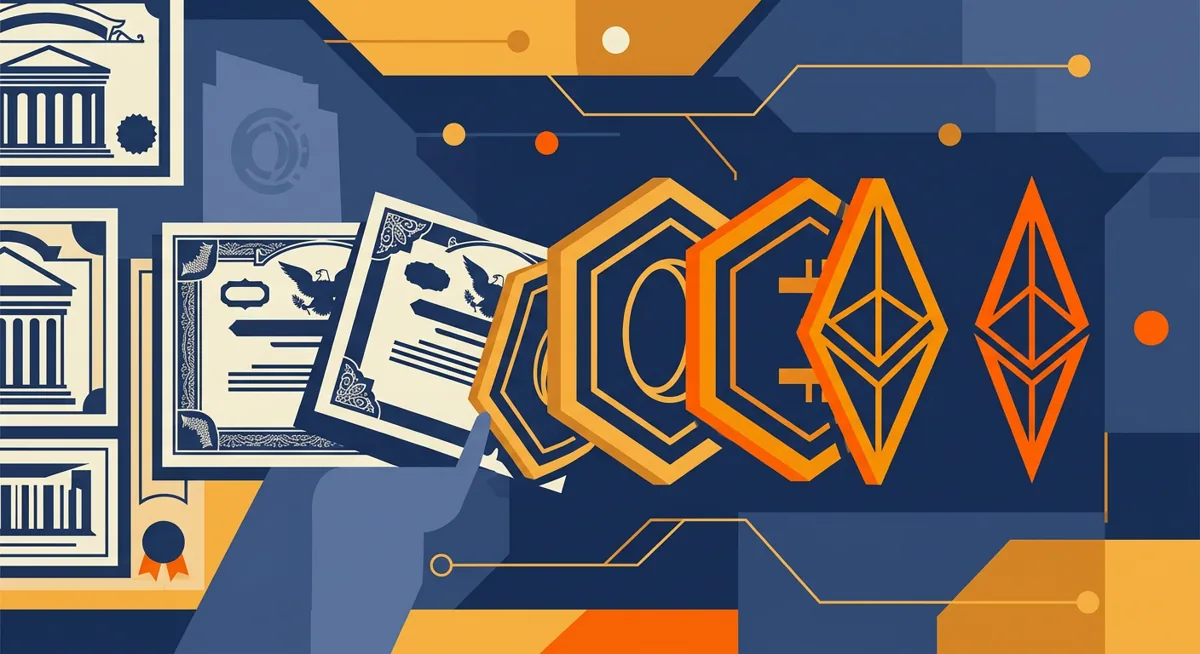
OKX operates a division called OKXICE, which issues tokens designed to track the stock prices of publicly traded companies. Purchasing one of these tokens does not grant the user any actual shares, voting rights, or any legal rights with respect to the company. It is a synthetic instrument pegged to a price feed, issued and maintained by the exchange, not by the company whose name appears in the token’s name.
Currently, several companies have officially objected to being included on this list. According to a report cited by the author of the article as a news source, these companies include CoreWeave, Broadcom, and Verizon. The main complaint is simple: these companies claim that OKX created products that mention their stock prices without their permission, without any licensing agreement, and without any formal relationship between OKX and the respective company.
None of the companies that raised objections issued the relevant token themselves, and, apparently, none of them authorized OKX to use their stock price as a benchmark for the traded product. This distinction is significant because it means that the objection goes beyond the exchange’s own terms of service—it is a third-party complaint about how company and price data were used, rather than a dispute between OKX and its own users.
It’s also worth clarifying exactly what hasn’t changed. This does not mean that cryptocurrency trading, account deposits, or withdrawals have been suspended on OKX. Spot trading and standard cryptocurrency services constitute a separate line of business, distinct from OKXICE’s stock tokenization function. As previously mentioned, the dispute is narrow in scope: whether an exchange can convert the stock price of a public company into a token without that company’s prior consent.
Brief summary: The objection concerns consent to the tokenization of stock prices, not OKX’s cryptocurrency services as a whole.
Who is affected
Three groups have a direct stake in how events unfold.
First, the companies themselves. The names and stock prices of CoreWeave, Broadcom, Verizon, and other companies that raised objections were used as a benchmark for a product that, according to them, they never endorsed. For these companies, this is a matter of reputation and legal consequences, rather than a financial risk related to OKX’s own reporting—their stock prices and trading continue regardless of what happens to the token that references them.
Second, any holder of OKXICE tokens linked to the companies that filed objections. If a company succeeds in having its tokenized product delisted, holders may find that the token is delisted, trading is suspended, or circulation ceases at short notice. Tokenized products on a cryptocurrency exchange do not provide the same investor protections as a brokerage account holding actual stocks, so in the event of a sudden delisting, the holder’s options are limited to what the exchange’s own terms and conditions permit.
Third, traders in the U.S. are trying to figure out whether any of this affects them at all. In this particular case, the information published by OKX itself is more important than the dispute itself. The deposit methods documented by OKX, SEPA/SEPA Instant, Visa & Mastercard, PayPal, are the options listed by the exchange for funding an account, and the list of supported countries associated with these methods, El Salvador, Argentina, The Bahamas, Belize, Bolivia, Brazil, Chile, Colombia, Costa Rica, Dominican Republic, Ecuador, Guatemala, Guyana, Honduras, Mexico, Nicaragua, Panama, Paraguay, Peru, Suriname, Uruguay, does not include the U.S. A reader from the U.S. who asks whether it is even possible to fund an OKX account using a card or bank transfer is posing a question to which there is no affirmative answer in the list published by OKX—regardless of what is happening with OKXICE and the companies objecting to this.
In short: Companies are facing a reputational dispute, token holders are facing the risk of delisting, and U.S. traders are facing a more fundamental access issue—all before any of these situations directly affect them.
OKX's deposit menu and the US access question
In addition to the dispute with OKXICE, it’s worth examining what information OKX actually publishes regarding account deposits on the platform, since this aspect can be verified today without waiting for any corporate disputes to be resolved.
| What is | Learn more |
|---|---|
| Deposit methods offered by OKX | SEPA/SEPA Instant, Visa & Mastercard, PayPal |
| Countries listed as supported by this "on-ramp" | El Salvador, Argentina, The Bahamas, Belize, Bolivia, Brazil, Chile, Colombia, Costa Rica, Dominican Republic, Ecuador, Guatemala, Guyana, Honduras, Mexico, Nicaragua, Panama, Paraguay, Peru, Suriname, Uruguay |
Two points stand out here. The listed deposit methods are geared toward European payment systems—SEPA transfers are a eurozone mechanism, and the options involving cards and PayPal are not described anywhere as products designed specifically for the U.S. Second, the United States is not mentioned at all in the list of countries that OKX publishes for this deposit method. This does not necessarily mean that a U.S. resident cannot open an account on OKX—exchanges often establish separate legal entities, offer limited products, or maintain waiting lists for U.S. users who are not included in the general list of countries, — but it does mean that the information provided above regarding deposit methods and countries does not constitute proof that the platform is available to U.S. users, and U.S. readers should not interpret it as evidence one way or the other.
This context is particularly significant for the history of OKXICE. Tokenized stock products are precisely the type of instruments that attract close scrutiny from regulators, since under U.S. securities law, a token that tracks the share price of a U.S. company may be considered a potential security, regardless of how the exchange classifies it. Add to this the list of countries and the depository—in which the U.S. is not mentioned—and the conclusion for a U.S. trader is clear: do not assume that you will have access to OKXICE tokens at all, regardless of whether a particular company objected to its inclusion on the list.
Quick summary: Before worrying about which specific stock tokens are in dispute, check which country the OKX platform is registered in and what the account funding terms are—access to the platform is what matters most.
What to do next
If you are a reader in the U.S. who is trying to make a decision today, approach this as a situation that requires careful consideration, rather than one where you should simply wait and see how things turn out.
- Check your account status directly. Log in to OKX and verify whether your account shows access to OKXICE products, rather than relying on marketing pages or general country lists.
- Check the deposit options available based on your location. The deposit methods published by OKX, SEPA/SEPA Instant, Visa & Mastercard, PayPal, and the list of countries associated with that deposit channel, El Salvador, Argentina, The Bahamas, Belize, Bolivia, Brazil, Chile, Colombia, Costa Rica, Dominican Republic, Ecuador, Guatemala, Guyana, Honduras, Mexico, Nicaragua, Panama, Paraguay, Peru, Suriname, Uruguay, serve as a starting point, but the final decision on how and through which method you can deposit funds is made on your account dashboard.
- If you hold a tokenized equity product linked to CoreWeave, Broadcom, Verizon, or another company that has raised objections, please carefully review OKX’s notifications regarding that specific token. Delisting notices from exchanges often provide a short window to close your position before trading is suspended.
- Compare other deposit methods before considering OKX as your only option. If funding methods or country support are an issue, it may be worth exploring how Coinbase provides access to U.S. IPOs or comparing fee structures and withdrawal options across different exchanges before investing anywhere.
- Do not consider stock tokens on any exchange to be equivalent to owning actual shares. Voting rights, dividends, and legal claims against the company are not transferred along with these tokens, regardless of any disputes.
Quick summary: First, check whether you have access to your account and sufficient funds—the corporate dispute is irrelevant if you didn't have access to OKXICE to begin with.
References
| # | Source | Reliability | Checked |
|---|---|---|---|
| 1 | okx.com — Deposit methods | Official source | 2026-09-18 |
| 2 | okx.com — Supported countries | Official source | 2026-09-18 |