OKX Money essentially combines features that were already available on OKX into a single wallet, and the only real new feature is the advertised returns on stablecoins. If you hold dollar-pegged stablecoins on the exchange or are deciding where to park your funds between trades, it’s worth taking five minutes to check this out.
In short
- According to the report in which this news first appeared, OKX has launched an app called OKX Money, which allows users to store, earn the advertised returns on, and spend dollar-pegged stablecoins all from a single wallet.
- OKX's base-level spot trading fees remain unchanged: 0.08% for "makers" and 0.10% for "takers."
- Moving crypto off OKX entirely still costs a flat 1 DOGE network withdrawal fee, separate from anything inside the Money app.
- OKX accepts funds via SEPA/SEPA Instant, Visa & Mastercard, PayPal and lists the countries where the platform is available, including El Salvador, Argentina, The Bahamas, Belize, Bolivia, Brazil, Chile, Colombia, Costa Rica, Dominican Republic, Ecuador, Guatemala, Guyana, Honduras, Mexico, Nicaragua, Panama, Paraguay, Peru, Suriname, Uruguay.
- The report did not detail lock-up terms, caps, or tiering on the advertised yield, so that's the first thing to check before moving a balance.
Key facts
| OKX | |
|---|---|
| Fees | Spot maker fee (base tier): 0.08% Spot taker fee (base tier): 0.10% Crypto withdrawal fee: 1 DOGE |
| Limits | — |
| Deposit methods | Deposit methods: SEPA/SEPA Instant, Visa & Mastercard, PayPal |
| Country availability | Supported countries: El Salvador, Argentina, The Bahamas, Belize, Bolivia, Brazil, Chile, Colombia, Costa Rica, Dominican Republic, Ecuador, Guatemala, Guyana, Honduras, Mexico, Nicaragua, Panama, Paraguay, Peru, Suriname, Uruguay |
What changed: saving, yield and spending folded into one app
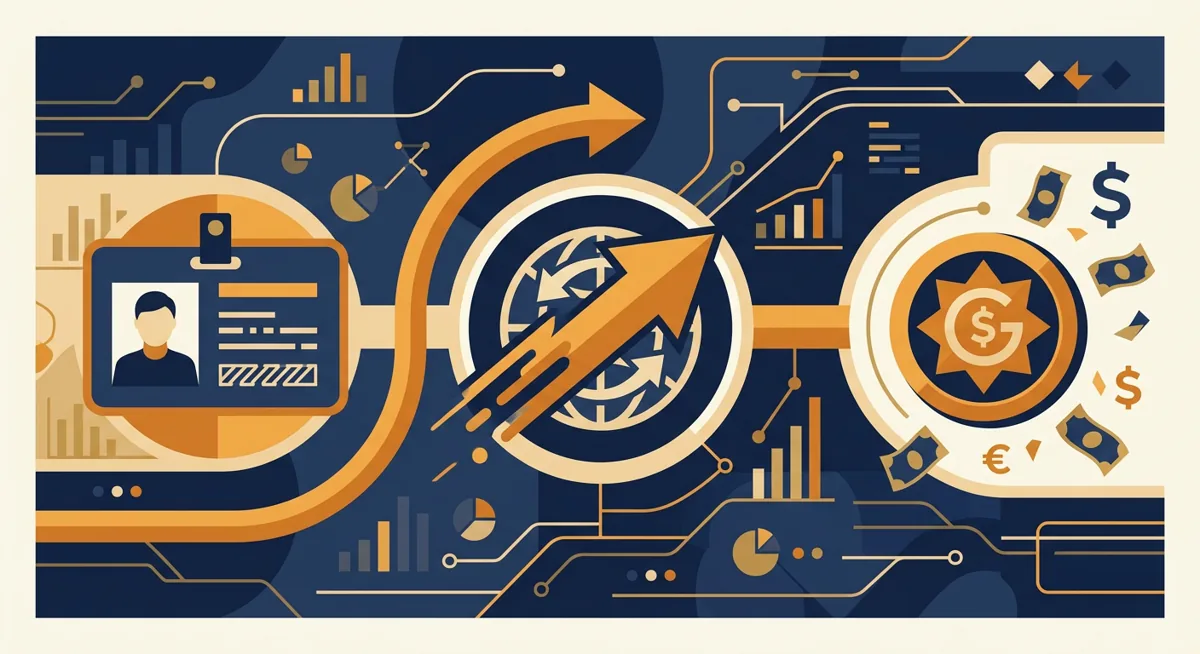
According to the report in which this news first appeared, OKX has launched an app called OKX Money, which allows users to store, earn interest on, and spend dollar-pegged stablecoins all from a single wallet. That is the whole point of the article that prompted this post: a unified interface for three functions that, on most exchanges—including OKX itself—have traditionally been housed in separate menus: a balance for funding an account or trading, a product for earning income or saving, and a card or payment channel for spending.
Nothing in the original article mentions a new token, a new blockchain, or a new storage model. It refers to a wallet that unifies existing platforms under a single name. The main reason for attention is the yield itself, which the article describes as a double-digit annual return on dollar-pegged stablecoins, though it does not specify whether this is a promotional claim, whether it depends on the balance size, whether it is account-specific, or whether it is subject to a lock-up period. None of these details were included in the original report, which is why they are not mentioned here either.
What remains unchanged: OKX’s standard trading terms. If a user converts funds to or from a stablecoin via the spot market’s main order book—rather than through the Money app’s built-in conversion process— OKX’s standard spot trading fees still apply—for makers: 0.08%, for takers: 0.10%. And if someone decides that the returns do not justify the costs and wants to transfer their stablecoins to a completely different platform, the standard OKX cryptocurrency withdrawal fee of 1 DOGE will still apply, as this is a fixed network fee rather than an app-specific fee.
Why This Is Important When Comparing Prices
The advertised return on a stablecoin balance is not the same as a trading fee or a withdrawal fee. It is a separate product with its own terms and conditions, and the fact that it is included in a more “attractive” wallet does not tell you what those terms are. A practical comparison criterion for readers is not whether “the yield is good” — a question this article cannot answer without specific figures that OKX has actually published as fee schedules — but whether the costs of depositing and withdrawing funds from OKX have changed. They have not changed.
Conclusion: OKX Money is a new interface built on the old infrastructure; trading and withdrawal fees remain the same.
Who this affects
This applies to a smaller group of people than one might assume from the headline.
- Existing OKX users who already hold dollar-pegged stablecoins. They now have the ability to view and transfer this balance, and they don’t need to take any action to continue using OKX just as they did before.
- People comparing stablecoin storage options between trades. The savings feature built into the exchange’s app is now included in the set of criteria for comparison alongside other exchanges or deposit channels that the reader already uses.
- Users in markets actively served by OKX. The list of countries where OKX operates includes El Salvador, Argentina, The Bahamas, Belize, Bolivia, Brazil, Chile, Colombia, Costa Rica, Dominican Republic, Ecuador, Guatemala, Guyana, Honduras, Mexico, Nicaragua, Panama, Paraguay, Peru, Suriname, Uruguay, and deposit methods are listed at SEPA/SEPA Instant, Visa & Mastercard, PayPal. This is important because advertised returns are useless if it’s impossible from the start to fund your account inexpensively in your own currency.
- Readers assessing counterparty risk when holding funds on a single exchange. This issue is not new to OKX Money — it arises whenever the situation on an exchange changes dramatically, as in the case of BitMEX suspending trading while allowing withdrawals and the subsequent discussion what happens to your account when a platform ceases operations. Funds held in the app are still recorded in the exchange’s accounting books.
This does not apply to those who do not hold stablecoins at all or who already use a specialized savings or lending product elsewhere and have no reason to switch. There is also no mention here of derivatives, perpetual contracts, or margin accounts—in this case, we are specifically talking about a wallet for spending and savings, not a trading product.
Conclusion: This is primarily relevant for stablecoin holders and users of account-funding services, rather than for active traders or participants in the derivatives market.
What to check before moving stablecoins into OKX Money
Don't act on the headline alone. Here's the order to check things in.
- Read the actual yield terms inside the app, not the marketing copy. The trigger report didn't specify lock-up length, balance caps, or whether the rate is promotional and scheduled to drop. Exchanges have a long history of advertising a headline rate that applies to a small first tranche of a balance.
- Price the round trip you'd actually pay. If moving stablecoins in or out involves a spot conversion, OKX's base-tier fees are maker 0.08% and taker 0.10%. If you later decide to leave with crypto rather than cash, budget for the flat withdrawal fee of 1 DOGE.
- Confirm your funding route works for your situation. OKX's deposit methods include SEPA/SEPA Instant, Visa & Mastercard, PayPal. If your bank or card doesn't play well with one of those rails, the yield is irrelevant until the money actually lands.
- Check that your country is covered. OKX lists coverage including El Salvador, Argentina, The Bahamas, Belize, Bolivia, Brazil, Chile, Colombia, Costa Rica, Dominican Republic, Ecuador, Guatemala, Guyana, Honduras, Mexico, Nicaragua, Panama, Paraguay, Peru, Suriname, Uruguay. If you're outside that list, you're looking at a different on-ramp or a workaround that may conflict with the platform's terms of service — not something to improvise around a yield product.
- Compare against other ways exchanges monetize idle balances, since a savings yield isn't the only product in this category. Coinbase, for instance, has gone the other direction with fixed-rate BTC loans via Morpho Midnight — a different mechanism, different collateral, different risk. Reading both before committing a balance anywhere is the point.
- Keep an exit plan written down, specifically what it costs and how long it takes to get the full balance back out if the yield terms change or the app behaves unexpectedly. The only number confirmed in the source material and OKX's own schedule is the flat network withdrawal cost; everything about yield penalties or lock-up exit costs is unconfirmed and should be checked directly in-app, not assumed.
Takeaway: treat OKX Money as a new wallet layer worth five minutes of due diligence, not a reason to skip comparing it against what you already pay elsewhere.
References
| # | Source | Reliability | Checked |
|---|---|---|---|
| 1 | okx.com — Spot maker fee (base tier) | Official source | 2026-09-29 |
| 2 | okx.com — Spot taker fee (base tier) | Official source | 2026-09-29 |
| 3 | okx.com — Crypto withdrawal fee | Official source | 2026-09-27 |
| 4 | okx.com — Deposit methods | Official source | 2026-09-18 |
| 5 | okx.com — Supported countries | Official source | 2026-09-18 |