In short: A cryptocurrency exchange’s demo mode or testnet mode is good for familiarizing yourself with the order placement window and testing API logic, but it tells you practically nothing about actual fees, real liquidity, or whether you can even open a real account in your country. This information is intended for anyone comparing demo accounts or exchanges on a test network, or trying to trade cryptocurrency in “paper trading” mode before funding a real account—especially if Binance is on your list of potential options.
In short
- The Binance Public Testnet is intended for developers testing API calls and order processing logic, not for beginners as a “practice mode” with simulated fiat funds in the main app.
- Funds, balances, and transaction history on a test network or in a demo environment have no real value and cannot be withdrawn or converted into a real balance.
- After switching to an account with a funded balance, a 0.1% and an instant purchase fee of up to up to around 2% will apply; these fees are not accurately simulated in the test environment.
- When funding a live account, the minimum deposit requirements (Minimum deposit amounts vary by currency and method) still apply, regardless of how long you have been practicing on the test network.
- Country availability differs sharply: a long list of restricted locations (American Samoa, Canada, Cuba, Cyprus, Guam, Indonesia, India, Iran, Japan, North Korea, Northern Mariana Islands, Philippines, Puerto Rico, Russia, Singapore, Thailand, Ukraine (Crimea Region incl. Donetsk, Luhansk, Zaporizhzhia and Kherson as well as the Crimea Peninsula), United States Minor Outlying Islands, USA, Vietnam, Virgin Islands (U.S.), Malaysia, Netherlands, United Arab Emirates, United Kingdom.) cannot use the live product, while the Binance App is confirmed supported in places such as Countries/Regions where the Binance App is supported: El Salvador.
Key facts
| Binance | |
|---|---|
| Fees | Spot maker fee (base tier): 0.1% Instant buy / card purchase fee: up to around 2% |
| Limits | Minimum deposit: Minimum deposit amounts vary by currency and method |
| Deposit methods | — |
| Country availability | Restricted countries: American Samoa, Canada, Cuba, Cyprus, Guam, Indonesia, India, Iran, Japan, North Korea, Northern Mariana Islands, Philippines, Puerto Rico, Russia, Singapore, Thailand, Ukraine (Crimea Region incl. Donetsk, Luhansk, Zaporizhzhia and Kherson as well as the Crimea Peninsula), United States Minor Outlying Islands, USA, Vietnam, Virgin Islands (U.S.), Malaysia, Netherlands, United Arab Emirates, United Kingdom. Supported countries: Countries/Regions where the Binance App is supported: El Salvador |
Before you start: what a demo account actually gives you
Most exchanges divide "practice" tools into two distinct categories, and mixing them up is the main source of confusion.
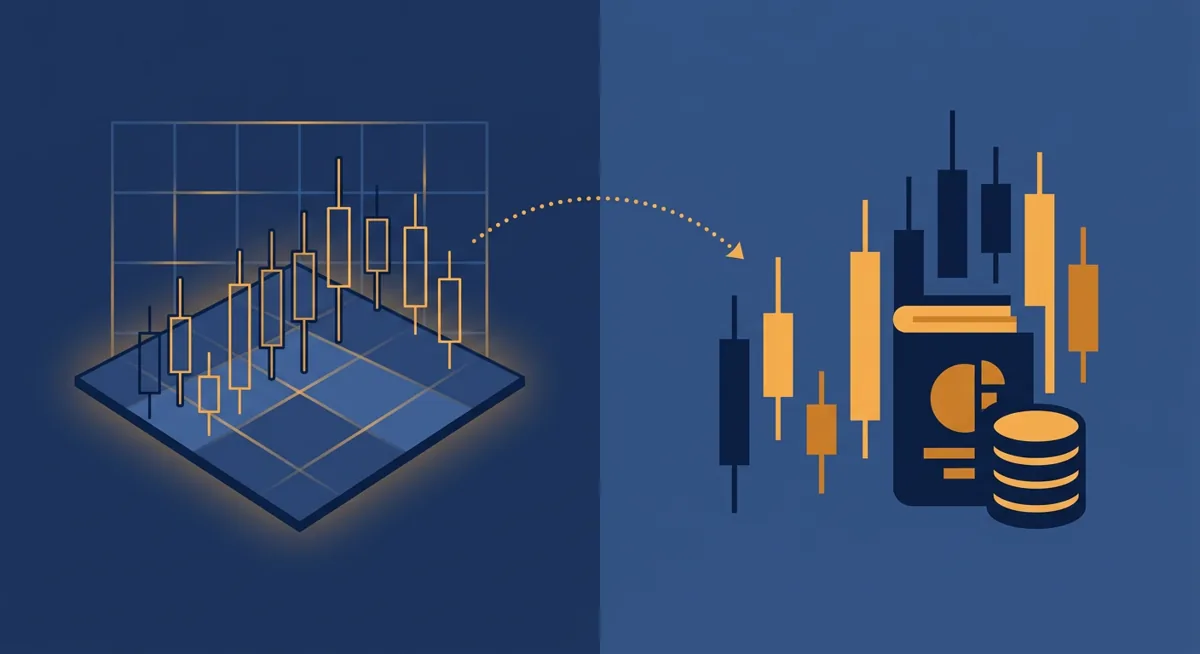
Testnet is a testing environment designed for developers and experienced traders to test order placement, API integration, and automated strategies. It typically operates on a separate domain, uses separate login credentials, and provides free test tokens that have no market value.
Paper trading / demo trading is more like a simulator: you click buttons in an interface that resembles the real one, and your virtual balance changes based on real-time or delayed quotes. It is intended for beginners learning the basics of how the order book works, not for stress-testing code.
Binance's public offering clearly falls into the first category. Its Futures Testnet is designed for those testing API integration and order processing logic based on an isolated matching mechanism, not for those who have never placed spot orders before. The main Binance app does not have a permanent “practice mode” for users with built-in simulated fiat funds, as some brokerage apps offer.
Before registering for any test network or demo version of a product, please have the following ready:
- A work email address that is different from (or the same as, depending on the service) your primary Exchange login.
- Realistic expectations regarding what exactly is being tested: familiarity with the interface, order types, or API behavior.
- An understanding that your actions here have no impact on the status of your identity verification. Demo accounts and the KYC process are separate procedures; logging out of the test network does not in any way bring you closer to obtaining a verified account into which you can deposit funds. To get a better understanding of how verification levels work once you switch to live trading, check out our guide Comparison of Verification Limits on Cryptocurrency Exchanges.
If your real goal is to buy cryptocurrency with real money—rather than testing the software—then a demo account is a completely unsuitable starting point. Instead, go straight to the step-by-step guide to getting started with cryptocurrency.
Conclusion: Before you sign up, decide whether you need a developer test environment or a simulator for beginners, since Binance actually only offers the former.
Steps: setting up a practice run on Binance
- Determine exactly what you’re testing. Whether you’re testing the logic behind order processing in the API, latency, or bot behavior, the test network is the right tool for the job. However, if you simply want to understand “what a limit order looks like,” it might be more helpful to place a small live trade with a minimal volume than to use a test environment.
- **Register separately for the testnet environment. Login credentials, API keys, and balances on the testnet are not synchronized with your main Binance account. Think of it as a separate product that just shares the same brand.
- Fund your testnet wallet with free test tokens. These are distributed by the platform itself and have no market value; you cannot buy, sell, or withdraw them anywhere.
- Replicate your intended live trading setup. Use the same trading pairs, order types, and position sizing logic as you would in live trading. The goal is to test your strategies, not to predict prices.
- Record your results and edge cases, especially anything that went unnoticed: rejected orders, frequency limits, or unexpected executions. Test networks are also used to identify such situations before they lead to financial losses.
- Only switch to a live account when you are satisfied with the results, and complete the identity verification process separately. For details on Binance’s settings and tiers, see Binance Explained: Setup, Fees, Limits, Availability.
- Be prepared for the fact that your first real trade will be subject to the actual fee schedule, not the one simulated by the test environment (if it simulated fees at all).
Conclusion: The stages of the test network are designed to verify the system's behavior, not to simulate the exact financial results you would receive when using real money.
Fees and limits: what changes the moment you go live
Using a demo environment and a test network generally doesn't involve any costs, since no real transactions take place there. The difference becomes apparent once you fund a live account.
There are a few points worth noting in this table:
- The instant purchase fee of up to up to around 2% is an aspect that new users most often underestimate, since experience on the testnet in no way suggests that quickly converting fiat funds into cryptocurrency is significantly more expensive than placing a standard limit order with the market maker’s base fee of 0.1%.
- Minimum deposit amounts are not fixed across the board; they vary depending on the currency and payment method (Minimum deposit amounts vary by currency and method), so the testnet experience, where “you can deposit any amount for free,” does not reflect the actual minimum amounts you will encounter in a live trading environment.
- Country restrictions apply in the live version of the product regardless of how much you’ve practiced on the test network. The list of restricted countries (American Samoa, Canada, Cuba, Cyprus, Guam, Indonesia, India, Iran, Japan, North Korea, Northern Mariana Islands, Philippines, Puerto Rico, Russia, Singapore, Thailand, Ukraine (Crimea Region incl. Donetsk, Luhansk, Zaporizhzhia and Kherson as well as the Crimea Peninsula), United States Minor Outlying Islands, USA, Vietnam, Virgin Islands (U.S.), Malaysia, Netherlands, United Arab Emirates, United Kingdom.) is quite extensive and includes major markets, while the Binance app is confirmed to be supported in regions such as Countries/Regions where the Binance App is supported: El Salvador. There is no guarantee that the rules for accessing the test network and the requirements for opening a live account will be the same.
To get a better understanding of how limits and verification levels differ across various exchanges, be sure to read the article “Comparison of Verification Limits on Cryptocurrency Exchanges” at](/guides/crypto-exchange-verification-limits-compared/) before funding your account.
Conclusion: Trading on the demo account does not “waive” any fees or minimum deposit requirements; both apply once you fund your live account.
Troubleshooting: common demo and testnet problems
Testnet balance resets or disappears. Sandboxes get wiped periodically for maintenance or abuse prevention. If you were relying on testnet history for anything persistent, you shouldn't have been; treat every session as disposable.
Order fills look nothing like live trading. Testnet liquidity is thin or artificial, so slippage and fill speed on a demo order rarely match a live order book. Don't use testnet fill quality to judge whether a strategy will work with real depth.
Confusing a testnet URL with the live domain. Because testnet runs on a separate address, phishing pages sometimes mimic it to harvest credentials. Only use links from the exchange's own verified documentation, and never enter your main account password into a testnet login screen.
Access blocked despite being "just a test." Some regions block access to an exchange's domains entirely, testnet included, if the exchange restricts that country at the corporate level. If you're in a location on the restricted list (American Samoa, Canada, Cuba, Cyprus, Guam, Indonesia, India, Iran, Japan, North Korea, Northern Mariana Islands, Philippines, Puerto Rico, Russia, Singapore, Thailand, Ukraine (Crimea Region incl. Donetsk, Luhansk, Zaporizhzhia and Kherson as well as the Crimea Peninsula), United States Minor Outlying Islands, USA, Vietnam, Virgin Islands (U.S.), Malaysia, Netherlands, United Arab Emirates, United Kingdom.), don't assume the sandbox is exempt from that policy.
Fee shock after going live. The single most common complaint: a new user practices for weeks on a zero-fee sandbox, then is surprised that a quick card purchase on the live account costs up to up to around 2%, or that the standard maker fee of 0.1% applies to every spot trade. The fix isn't a setting, it's expectations; read the fee schedule before funding, not after.
Demo credentials don't carry over to a verified account. Finishing KYC on a live account is a separate process from anything you did on testnet. If you're stuck at verification, that's a different troubleshooting path entirely, covered in our Binance Explained guide.
Takeaway: most testnet complaints trace back to treating a sandbox as predictive of live conditions, when it was only ever built to test software behavior.
Questions
Does Binance offer a demo trading account for beginners?
But not in the sense of a built-in simulator with fictional fiat currencies within the main app. The Binance public testnet is intended for developers and API users who are testing order-processing logic, not for beginners who are just learning how to place their first trade.
Is testnet trading the same as paper trading crypto?
They overlap but aren't identical. Paper trading usually means clicking through a realistic interface with a simulated balance; testnet means a genuinely separate sandbox environment, often used for API and bot testing rather than manual practice.
Can I convert testnet or demo funds into real money?
No. Test tokens and demo balances have no market value and cannot be withdrawn, transferred, or converted into anything that can be used in a live account.
Do the usual fees apply while using a demo or testnet account?
No, because no actual trade takes place. After funding a live account, standard fees apply, including a base fee for market makers of 0.1% and a fee for instant purchases of up to up to around 2%.
Which countries can't access Binance at all, demo or otherwise?
Binance lists a long set of restricted locations (American Samoa, Canada, Cuba, Cyprus, Guam, Indonesia, India, Iran, Japan, North Korea, Northern Mariana Islands, Philippines, Puerto Rico, Russia, Singapore, Thailand, Ukraine (Crimea Region incl. Donetsk, Luhansk, Zaporizhzhia and Kherson as well as the Crimea Peninsula), United States Minor Outlying Islands, USA, Vietnam, Virgin Islands (U.S.), Malaysia, Netherlands, United Arab Emirates, United Kingdom.), and account or app access in those places is generally blocked regardless of whether you're trying to reach a live or testnet environment.
References
| # | Source | Reliability | Checked |
|---|---|---|---|
| 1 | binancemakertakerfee.org — Spot maker fee (base tier) | Aggregator — less reliable | 2026-10-02 |
| 2 | binance.com — Instant buy / card purchase fee | Official source | 2026-09-30 |
| 3 | binance.com — Minimum deposit | Official source | 2026-09-16 |
| 4 | binance.com — Restricted countries | Official source | 2026-09-16 |
| 5 | binance.com — Supported countries | Official source | 2026-09-25 |