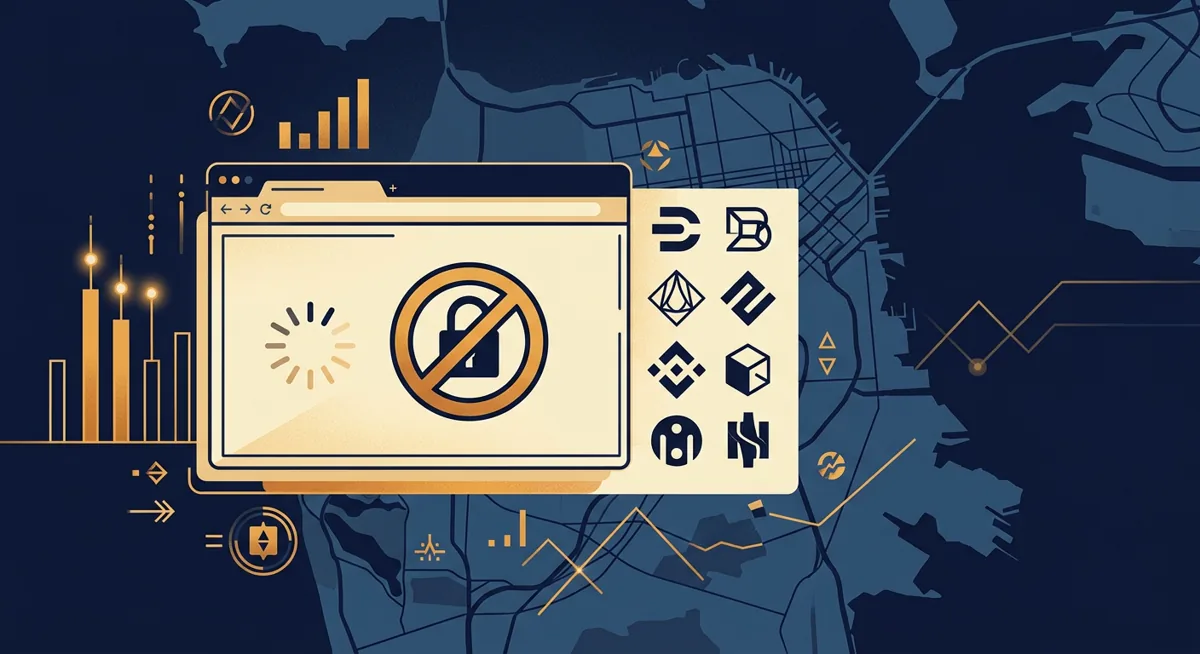
In short: According to CoinDesk, South Korea has blocked direct access to a number of cryptocurrency exchanges, specifically BitMart and KuCoin. Read this article if you have funds on one of these platforms, access them via a Korean network, or are comparing exchanges and want to know which ones are currently operating in this market.
In short
- According to a CoinDesk report, South Korea has blocked access to a number of cryptocurrency exchanges, including BitMart and KuCoin.
- The report does not list all the exchanges on the list, nor does it disclose the exact technical mechanisms underlying the suspension.
- An access block is not the same as an account freeze; users should check separately whether they can log in and withdraw funds before concluding that their funds have been affected.
- The base fees published by KuCoin are as follows: the maker fee on the spot market is 0.1%, and the taker fee is 0.1%. As of the publication of this post, these fees remain unchanged; however, they are irrelevant if the platform is inaccessible.
- Anyone checking out a new exchange in light of this restriction should review the exchange’s page on availability in different countries—for example, KuCoin’s page at Supported countries/regions—before beginning the identity verification process.
Key facts
| KuCoin | |
|---|---|
| Fees | Spot maker fee (base tier): 0.1% Spot taker fee (base tier): 0.1% Instant buy / card purchase fee: zero transaction fees |
| Limits | Minimum deposit: To avoid asset loss, always deposit more than the minimum deposit amount required by KuCoin, as shown on the page. |
| Deposit methods | — |
| Country availability | Supported countries/regions |
What changed
According to a CoinDesk report published this month, South Korea has blocked access to a number of centralized cryptocurrency exchanges, and the list explicitly mentions BitMart and KuCoin. The headline specifically mentions these two platforms. The version I’m working with does not provide a complete list of other affected exchanges, does not specify the exact legal grounds, and does not indicate specific dates for the implementation of these measures. I do not intend to fill in these gaps with speculation.
The report clearly defines the nature of the measures taken: it refers to blocking access, not to a warning, a fine, or removal from the app store. This is a significant difference. For many years, South Korea has required platforms serving its residents to register locally and conduct transactions in fiat currencies through partner banks in accordance with identity verification rules. Exchanges that circumvent this process typically continue to operate in a “gray area”—technically accessible but not officially authorized to serve Korean customers. A block is a more stringent enforcement measure: the platform becomes inaccessible through standard access channels.
Furthermore, based solely on this trigger, I cannot confirm whether this is being implemented at the internet service provider level, through removal from the app store, a ban on creating new accounts, or some combination of these measures. The phrase “blocks access” is used, and that is the only confirmed detail. Anything more specific than that is speculation, which I do not intend to present as fact.
What remains unchanged—since this information is published independently on KuCoin’s own website—is the exchange’s basic fee structure: the fee for “makers” on the spot market is 0.1%, and for “takers” — 0.1%, plus the stated policy zero transaction fees regarding instant purchases and purchases made with bank cards. None of this changes due to the network-level block. It simply ceases to matter for those who can no longer access the platform from South Korea.
Conclusion: The confirmed incident involves the blocking of access to the BitMart and KuCoin platforms; the scope, mechanism, and legal basis beyond the scope of this incident are not specified in the alert report.
Who is affected
Three groups need to think about this differently, because the practical impact isn't the same for each.
South Korean residents with active accounts. If you registered for BitMart or KuCoin with a South Korean address or phone number and you're currently connecting from inside the country, you may find the site or app simply fails to load. That's a connectivity problem first, not automatically proof of a frozen account. Treating the two as the same thing leads to panic decisions that aren't warranted by the facts in front of you.
People whose network location doesn't match their residency. Access blocks of this type are usually tied to routing, not identity. A Korean resident connecting through a VPN exit node abroad may find the platform still loads. Someone traveling into South Korea on a foreign SIM card might lose access they had the day before, at the same exchange, with the same account. This is exactly why a login failure alone shouldn't be read as a statement about account status.
Anyone comparing exchanges for the Korean market right now. If South Korea is relevant to where you buy or swap crypto, this block moves BitMart and KuCoin out of the realistic option set for the moment, independent of how their published terms compare to other platforms. For reference, here's what KuCoin states on its own fee and policy pages, separate from the access question entirely:
| Metric | KuCoin |
|---|---|
| Spot maker fee (base tier) | 0.1% |
| Spot taker fee (base tier) | 0.1% |
| Instant buy / card purchase fee | zero transaction fees |
| Minimum deposit | To avoid asset loss, always deposit more than the minimum deposit amount required by KuCoin, as shown on the page. |
| Supported countries | Supported countries/regions |
Those figures describe the platform in general, not a Korea-specific arrangement, and the country list at Supported countries/regions is the kind of page that's supposed to answer an availability question like this directly — assuming it's kept current, which is a separate check from anything in this article.
This isn't the first time users have lost access to a familiar venue with little warning and had to sort out what it actually meant for their funds. When BitMEX halted trading while leaving withdrawals open, the immediate question for users was never about the fee schedule — it was what actually happens to an account once the front door closes. The same order of operations applies here: figure out access and withdrawal status before anything else.
Takeaway: an access block correlates with network location, not necessarily with account status, so don't assume your funds are at risk just because a login page won't load.
What to do next
None of this is advice about whether to keep using BitMart or KuCoin, or what to do with any balance held on either platform. It's a short, practical checklist for sorting fact from assumption before you act on something you read secondhand.
- Confirm the block applies to your actual connection. Try switching from home broadband to mobile data, or the reverse. If the exchange loads on one network and not the other, that's a routing issue, not evidence your account has been frozen.
- Check withdrawal status separately from login status. A platform can be unreachable at the network level while withdrawals still process normally once you do connect. Don't assume the two are linked without checking directly, through official channels.
- Avoid unofficial mirrors or workaround apps to get around a block. That kind of improvisation is exactly what social-engineering fraud relies on. A Brooklyn man was sentenced for the kind of account-access scheme that thrives when frustrated users start looking for unofficial shortcuts.
- If you're evaluating a different exchange because this one is now unreachable, read the published country-availability page before you start identity verification, not after. KuCoin states its own coverage as Supported countries/regions; other platforms publish comparable pages. Read the actual list for your country rather than relying on a summary.
- Compare fee schedules only once access is confirmed, not before. A base-tier maker fee of 0.1% or taker fee of 0.1% means nothing if you can't reach the order book in the first place. Access comes first in the decision process; cost comparisons come second.
- Keep a record of what you see. A screenshot of an error message, the network type, and the time it happened is a useful support ticket. "It won't load" on its own generally isn't.
What I'd specifically avoid is drawing conclusions about either exchange's solvency or intentions from a government-side network block alone. A regulatory access restriction and a platform-side operational failure are different categories of problem, and the report this is based on describes the former, not the latter.
Takeaway: separate the access problem from the account problem, verify on your own connection before reacting, and treat any unofficial workaround as a warning sign rather than a fix.
References
| # | Source | Reliability | Checked |
|---|---|---|---|
| 1 | coinlive.io — Spot maker fee (base tier) | Aggregator — less reliable | 2026-10-09 |
| 2 | kucoin.com — Spot taker fee (base tier) | Official source | 2026-09-29 |
| 3 | kucoin.com — Instant buy / card purchase fee | Official source | 2026-10-09 |
| 4 | kucoin.com — Minimum deposit | Official source | 2026-09-18 |
| 5 | kucoin.com — Supported countries | Official source | 2026-09-21 |