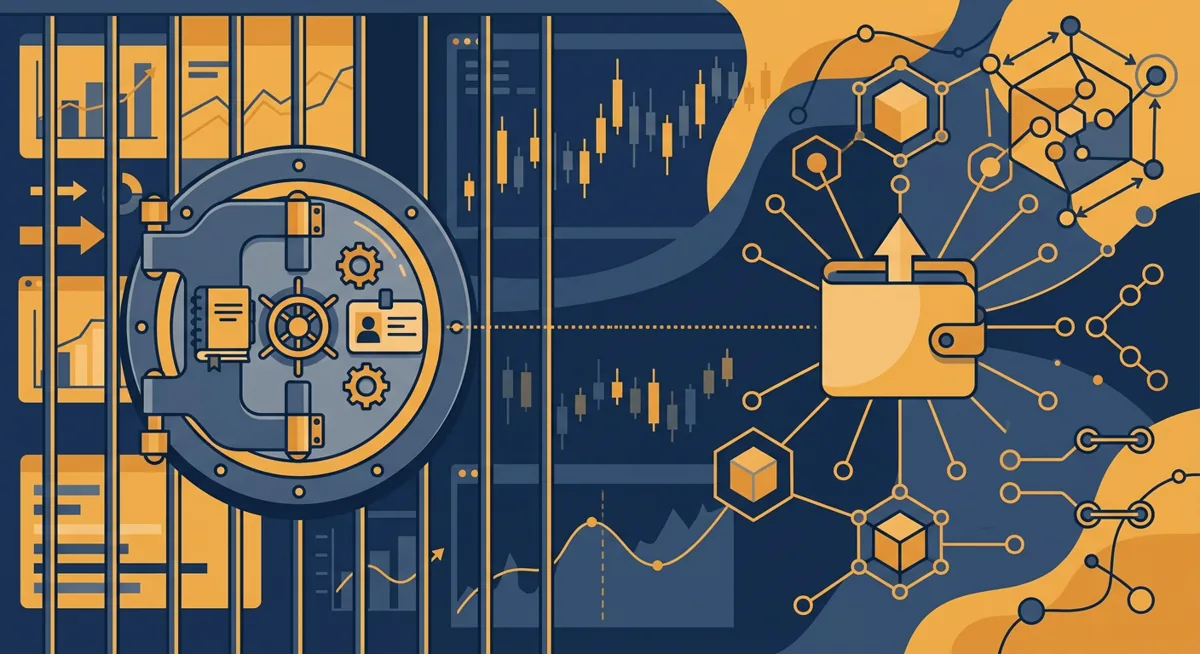
Short version: a centralized exchange verifies you and holds your coins; a decentralized exchange skips both steps and hands you a wallet address instead of a login. Read on if you're deciding whether to buy on Binance or Kraken, or route the same trade through a DEX and keep the keys yourself.
In short
- Binance's base spot maker and taker fees are both 0.100% / 0.100%; a DEX has no published maker/taker fee, only a pool fee plus gas.
- Kraken's minimum deposit is 1 USD, while Binance's minimum deposit varies by currency and method (Minimum deposit amounts vary by currency and method); a DEX has no company-set minimum at all.
- Binance restricts a long list of countries including American Samoa, Canada, Cuba, Cyprus, Guam, Indonesia, India, Iran, Japan, North Korea, Northern Mariana Islands, Philippines, Puerto Rico, Russia, Singapore, Thailand, Ukraine (Crimea Region incl. Donetsk, Luhansk, Zaporizhzhia and Kherson as well as the Crimea Peninsula), United States Minor Outlying Islands, USA, Vietnam, Virgin Islands (U.S.), Malaysia, Netherlands, United Arab Emirates, United Kingdom., and Kraken restricts a separate list including Prohibited regions: Afghanistan; Belarus; Crimea, Donetsk, and Luhansk regions of Ukraine; Cuba; Democratic Republic of the Congo; Iran; Iraq; Japan; Libya; North Korea; Russia; Sudan; South Sudan; Syria — a DEX contract itself doesn't check nationality, though its web front end sometimes geo-blocks.
- A CEX 'trade' means the exchange holds your coins until you withdraw; a DEX 'swap' exchanges assets directly from your own wallet with no custody step.
- Neither Binance nor Kraken lets verification be skipped; getting crypto onto a DEX in practice usually starts with a centralized on-ramp anyway.
Key facts
How centralized and decentralized exchanges differ
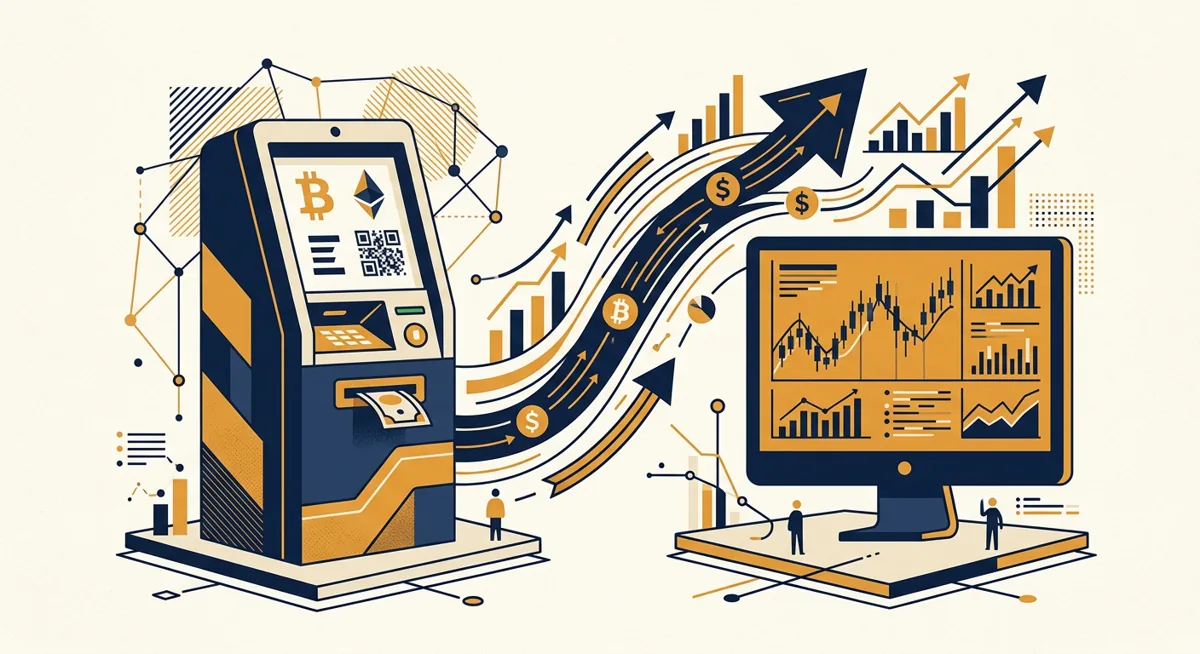
A centralized exchange (CEX) is a company. It takes your ID, holds your deposit, matches your order against its own order book, and publishes a fee schedule in advance. Binance's base spot maker fee is 0.100% and its taker fee is 0.100%. Kraken's minimum deposit is 1 USD, compared with Binance's minimum, which isn't a flat figure — it varies by currency and method (Minimum deposit amounts vary by currency and method).
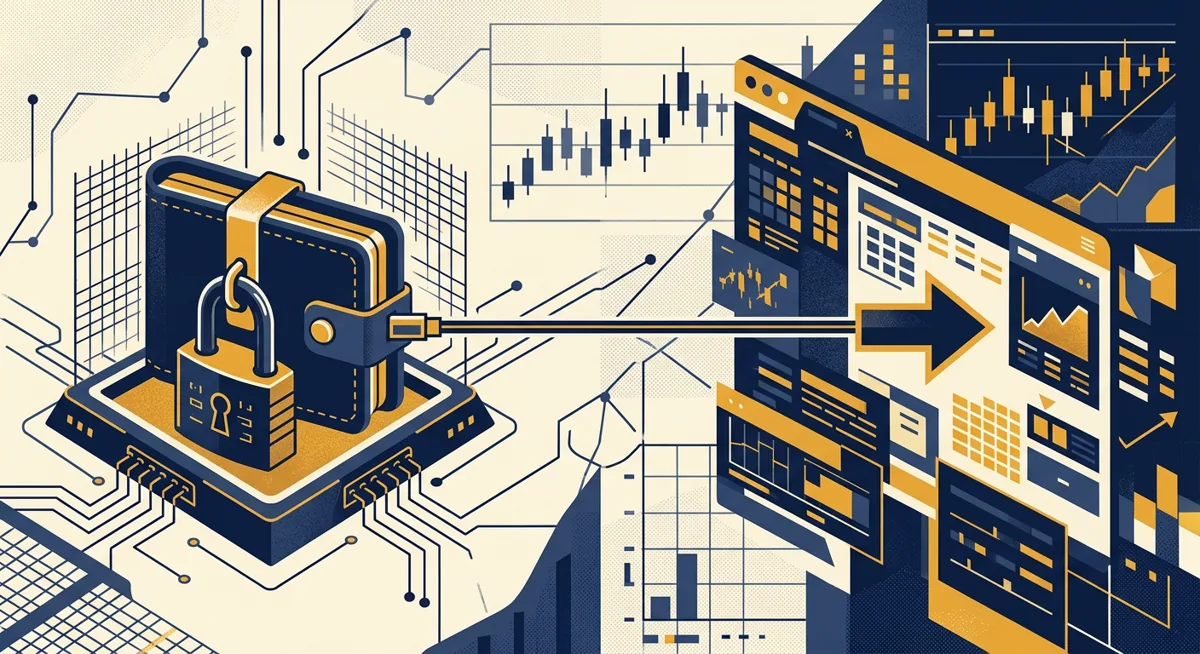
A decentralized exchange (DEX) is software, not a company. There's no sign-up form and no deposit minimum set by anyone, because there's no account — a smart contract holds a liquidity pool and you swap against it directly from a self-custody wallet. The cost isn't a maker/taker fee you can look up on a support page; it's a pool fee plus whatever gas the network charges at that moment.
Custody, verification, and how the fee gets calculated are the three things that actually change between the two models. Everything else — app design, coin list, chart tools — is styling on top.
One line: a CEX is a company you trust with your funds; a DEX is a contract you interact with directly.
Fee structure and verification side by side
CEX fees, as published
| Item | Binance | Kraken |
|---|---|---|
| Spot maker fee | 0.100% | not in this dataset |
| Spot taker fee | 0.100% | not in this dataset |
| Instant buy / card purchase fee | up to around 2% | not in this dataset |
| Minimum deposit | Minimum deposit amounts vary by currency and method | 1 USD |
Card purchases on a CEX cost more than spot trades — Binance's instant buy fee runs up to up to around 2%, well above its own maker or taker rate. That gap is standard across on-ramps; it's why a card buy followed by a spot trade is usually cheaper than one big card buy. See our Buy Crypto: Binance vs Coinbase vs Kraken Fees Compared for the full breakdown across three platforms.
DEX fees, by design
A DEX doesn't have a card-purchase fee, because it doesn't take cards. There's also no separate 'instant buy' tier — every swap goes through the same pool mechanism, so the cost is the pool's fee tier plus whatever gas the underlying network is charging at that moment. No verification step means no verification fee either, but it also means no support desk if a transaction goes to the wrong contract.
One line: CEX fees are a schedule you can read in advance; DEX costs are a pool rate plus a gas number that moves by the minute.
Deposit and account limits compared
| Binance | Kraken | Typical DEX | |
|---|---|---|---|
| Minimum deposit | Minimum deposit amounts vary by currency and method | 1 USD | none set by the protocol; effectively limited by network minimums and gas cost |
| Deposit methods | card, bank transfer, crypto — not itemized in this dataset | Bank Transfer (ACH), SEPA (EUR, CAD), Fedwire, SWIFT, Etana Custody Wire Transfer, crypto deposits, phone digital wallet, credit or debit card | wallet-to-contract only; no card, no bank wire |
| Withdrawal or daily caps | not in this dataset | not in this dataset | none imposed by the contract; limited by wallet balance |
Both CEXs raise limits as you clear higher verification tiers — more documents, higher caps. A DEX skips that ladder entirely. Its only real limit is what's already sitting in your wallet and how much gas you're willing to pay to move it.
One line: CEX limits scale with your verification level; DEX limits scale with your wallet balance and the gas you're willing to spend.
Where each option is actually available
Both restriction lists are long and don't overlap perfectly — Kraken blocks a set of sanctioned or high-risk jurisdictions, while Binance's list also includes several markets where it has pulled back for regulatory reasons rather than sanctions. Check the specific list before assuming either platform works where you live.
A DEX's smart contract doesn't check a passport or an IP address — it executes whatever transaction it's sent. In practice, though, the website you use to build that transaction often does check location, and some front ends geo-block visitors from certain countries even though the underlying contract would happily process the swap if you reached it another way. Availability on a DEX is really two separate questions: is the contract reachable, and is the front end willing to show it to you.
One line: CEX availability is a fixed list you can check in a policy page; DEX availability depends on which layer — contract or front end — you're actually asking about.
Custody and the swap-vs-trade distinction
A 'trade' on Binance or Kraken means your order gets matched against the exchange's order book, and the resulting coins sit in an account the exchange controls until you withdraw them. A 'swap' on a DEX means one asset is exchanged for another inside a smart contract, and the result lands straight in your own wallet — there's no point where a third party is holding the balance.
That difference is also why 'decentralized on-ramp' is a slightly misleading phrase. A DEX swaps crypto for crypto; it doesn't take a card or a bank transfer and hand you tokens in return. Getting from cash to crypto almost always means touching a centralized service first — a card purchase, a bank deposit, or a peer-to-peer transfer — before you ever reach a DEX's swap screen. Our How to Buy XRP on Binance: Fees, Limits, KYC guide walks through exactly that first step, which is the part a DEX can't do for you.
One line: a CEX trade means the exchange holds the coins until you say otherwise; a DEX swap never lets go of your custody in the first place.
Which fits which user
One line: pick a CEX for the on-ramp and the published fee schedule, and treat a DEX as the place you go after the coins already exist in your wallet.
Questions
What is a decentralized exchange, in plain terms?
It's a smart contract that lets you swap one token for another directly from your own wallet, without a company holding your funds or checking your ID at any point.
Centralized exchange vs DEX — which is cheaper?
Is there such a thing as an on-ramp decentralized enough to skip verification entirely?
Not really. A DEX swaps crypto for crypto. Turning cash into crypto in the first place almost always runs through a centralized service such as a card purchase or bank deposit, even if you move the coins off-platform immediately afterward.
What's the practical difference between a swap and a trade?
A trade on Binance or Kraken is matched against an order book and settles into an account the exchange controls. A swap on a DEX executes against a liquidity pool and settles straight into your own wallet, with no custody step in between.
Do Binance and Kraken restrict the same countries?
No. Binance's restricted list includes American Samoa, Canada, Cuba, Cyprus, Guam, Indonesia, India, Iran, Japan, North Korea, Northern Mariana Islands, Philippines, Puerto Rico, Russia, Singapore, Thailand, Ukraine (Crimea Region incl. Donetsk, Luhansk, Zaporizhzhia and Kherson as well as the Crimea Peninsula), United States Minor Outlying Islands, USA, Vietnam, Virgin Islands (U.S.), Malaysia, Netherlands, United Arab Emirates, United Kingdom., while Kraken's prohibited regions list includes Prohibited regions: Afghanistan; Belarus; Crimea, Donetsk, and Luhansk regions of Ukraine; Cuba; Democratic Republic of the Congo; Iran; Iraq; Japan; Libya; North Korea; Russia; Sudan; South Sudan; Syria. The two lists overlap in places but aren't identical, so check the specific one for your country.
References
| # | Source | Reliability | Checked |
|---|---|---|---|
| 1 | binance.com — Spot maker fee (base tier) | Official source | 2026-09-16 |
| 2 | binance.com — Instant buy / card purchase fee | Official source | 2026-09-16 |
| 3 | binance.com — Minimum deposit | Official source | 2026-09-16 |
| 4 | support.kraken.com — Minimum deposit | Official source | 2026-09-18 |
| 5 | kraken.com — Deposit methods | Official source | 2026-09-18 |
| 6 | binance.com — Restricted countries | Official source | 2026-09-16 |
| 7 | binance.com — Supported countries | Official source | 2026-09-25 |
| 8 | support.kraken.com — Restricted countries | Official source | 2026-09-18 |