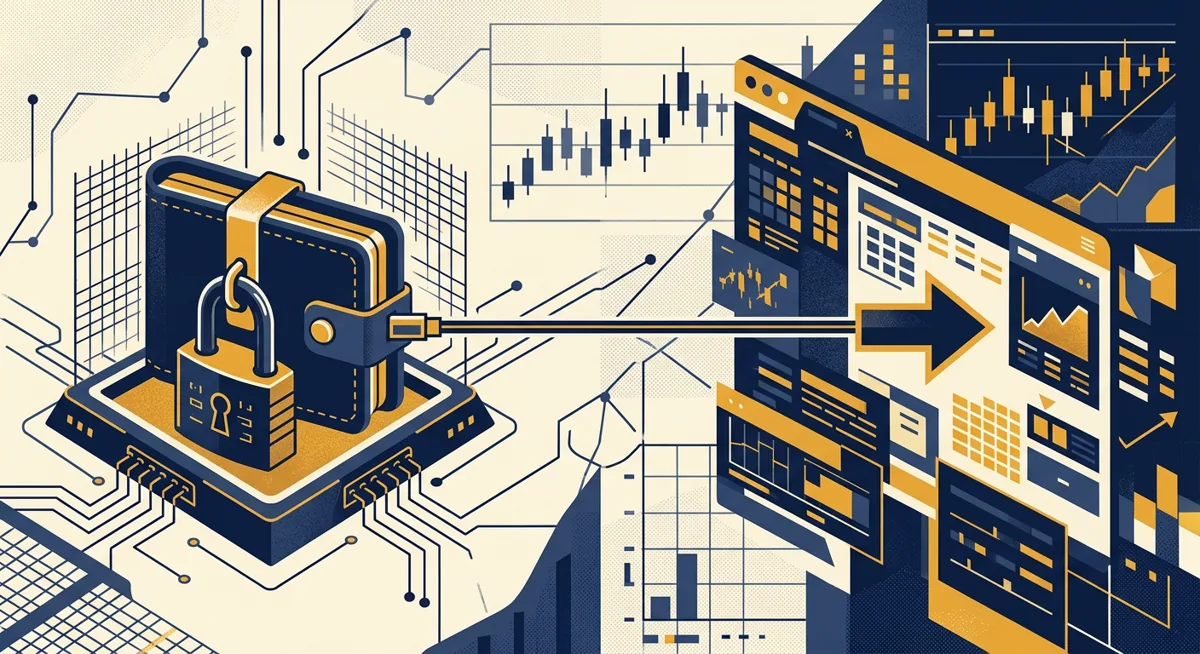
A digital broker sells you cryptocurrency at a fixed, specified price, rather than matching your order with other traders’ orders in real time. Read this article if you’re choosing between a broker-type platform, such as Coinbase, and a full-fledged exchange, and want to know exactly what the differences are in fees, limits, and verification procedures.
In short
- A digital broker sets a fixed price for each trade; a centralized exchange, on the other hand, matches orders based on the current order book.
- The pricing structure used by brokers is easier to use, but the markup is included in the final price rather than being listed separately as a commission.
- Coinbase acts as a broker for funding accounts with fiat currency on the main trading screen and sets a daily withdrawal limit on the website €100,000 per day.
- Identity verification requirements are the same across broker and exchange models — the difference is in execution, not compliance.
- A broker is suitable for small or infrequent purchases; an exchange is suitable for frequent trades, where spread costs add up over time.
Key facts
| Coinbase | |
|---|---|
| Fees | — |
| Limits | Daily withdrawal limit: €100,000 per day |
| Deposit methods | — |
| Country availability | — |
What a digital broker actually is
A digital broker is a platform that sells cryptocurrency directly to you at a price it sets, rather than connecting you with other buyers and sellers through an order book. You see the quote, accept it—and the trade is complete. There’s no need to monitor the spread between the bid and ask prices, and, as a rule, limit or stop orders are not available.
This model overlaps with what people call a “fiat on-ramp”—an entry point where a bank transfer or card payment is first converted into cryptocurrency. The basic process of buying and selling on Coinbase works exactly this way. The same applies to the standard “quick buy” button built into exchanges that also use a full-fledged order book, including Binance and Kraken. A cryptocurrency broker is, in essence, a user-friendly entry point for retail users to access these same platforms.
The catch is in the pricing. The platform’s margin is already factored into the quote. You won’t see a separate line item for a maker or taker fee, as you would when trading through an order book. This doesn’t mean that the broker channel is necessarily more expensive by default, but it makes it difficult to compare prices quickly, since one amount is itemized while the other is not.
Brief summary: A digital broker offers you a single price and a "Buy" button; it hides the spread within that price rather than listing it as a separate trading commission.
Digital broker vs centralized exchange, side by side
| Digital broker (e.g., buying/selling on Coinbase) | Centralized exchange (order book) | |
|---|---|---|
| Price Determination: The quoted price is displayed until confirmed | Real-time order book: The price may change while your order is open | |
| Transparency of Fees | Included in the spread; not listed separately | Fees for makers and takers are listed separately in the published price list |
| Order Types | Market orders only for buying/selling | Market, limit, and stop orders, as well as, in some cases, advanced order types |
| Verification: Standard identification levels; same provider as on the exchange side | The same verification process—this remains the same across both models | |
| Best suited for | — small or infrequent purchases; the ease of use of a single screen | — frequent trading, larger volumes, and control over the execution price |
Brief summary: Brokers offer a built-in markup in exchange for convenience; exchanges require a more complex learning curve in exchange for lower and more transparent fees.
For a general guide on how to fund your account for both models, see the article How to Buy Cryptocurrency: A Step-by-Step Guide for Beginners.
Before you start
- A government ID that matches the name on your bank account or card.
- A funded payment method — bank transfer, debit card, or linked account.
- An email address you control, since confirmation codes and security alerts go there.
- A rough idea of how much you're buying, since broker quotes are time-limited and re-quote if you stall on the confirm screen.
One-line takeaway: verification and funding requirements are identical to any exchange account; the broker screen doesn't skip either step.
How to buy through a digital broker
- Create an account and verify your email address.
- Complete identity verification—upload your ID and, in some cases, take a selfie to verify your identity, depending on the platform’s tier system.
- Link a bank account or card as a funding source.
- Select an asset and enter the amount; the platform will provide a fixed quote.
- Confirm the trade before the quote expires—most broker quotes are valid for a short period of time and expire after that period.
- The funds will be credited to your account balance, after which you can hold, convert, or withdraw them.
- Transfer the asset to an external wallet if you do not want it stored on the platform—see Transferring Cryptocurrency Between Wallets and Exchanges: Kraken for general guidelines.
For detailed information about Coinbase fees for this specific scenario, see the article “Buying Bitcoin on Coinbase: Fees, Limits, and Withdrawals” at](/guides/buy-bitcoin-on-coinbase-fees-limits-and-withdrawals/).
Brief summary: These steps are standard for any account opening process; the only step specific to this broker is the fourth one—that is, providing a fixed quote.
Fees and limits you'll run into
Digital brokers do not publish a fee schedule for “makers” and “takers” because such a schedule simply does not exist—the fee is built into the spread between the quote you see and the platform’s own cost basis. This is the fundamental trade-off: you pay for the convenience of not having to worry about order types or the dynamics of the order book.
Withdrawal limits apply even if the transaction itself does not include a separate line item for the fee. On Coinbase, the daily withdrawal limit is €100,000 per day. This limit is not tied to the buy/sell pricing mechanism—it determines how much you can withdraw from the platform per day, not how much you are allowed to purchase.
| Section | What governs it |
|---|---|
| "Buy/Sell" Spread Included in the quote; not listed separately | |
| Daily withdrawal limit (Coinbase) | €100,000 per day |
| The cost of this account-reload method | depends on the payment system—the fee for a bank transfer is usually different from the fee for a card payment |
| Verification Level Sets limits on deposits and withdrawals similar to those for exchange accounts |
If you’re comparing a broker’s spread to the commissions charged by a full-fledged exchange’s order book, make sure to do so for the same trade volume—the spread and the fixed percentage commission do not change in proportion to changes in volume. The guide Binance Explained: Setup, Fees, Limits, Availability examines the order book side for such a comparison.
Brief summary: The spread is the actual cost of the convenience provided by the broker; in addition, there are withdrawal limits that apply regardless of how the cryptocurrency was acquired.
Common problems and fixes
- The offer expired before you confirmed it. Enter the amount again—the platform generates a new offer each time, and it is not possible to lock in the previous price.
- Card payment declined. Some banks block merchant codes associated with cryptocurrencies; try a bank transfer instead, or read the article Can You Use Credit Cards on Cash App for Cryptocurrencies?, which provides detailed information on specific cards.
- Withdrawals are blocked or restricted. Before assuming there’s something wrong with your account, check to see if you’ve reached the platform’s daily limit—for Coinbase, it’s €100,000 per day.
- Verification is stuck in the review stage. This is part of the standard compliance review process and not a problem specific to a particular broker; it affects accounts on exchanges in the same way.
- Not sure how much you actually paid. Brokers don’t break down fees in the same detail as exchanges do, so compare the quoted price with the asset’s market price at that exact moment to estimate the spread.
- You need reports to file your tax return. Trade confirmations from brokers often contain few details; instead, download a full transaction export—see Cryptocurrency Taxes: Exporting Exchange Reports for Tax Filing.
Summary: Most of the problems brokers face stem from outdated quotes or restrictions imposed by payment systems, rather than from the brokerage business model itself.
Questions
Is a digital broker the same as a crypto broker?
Yes—these terms refer to the same model: a platform that sets the price and executes the trade on its own, rather than matching your order with those of other users.
Does Coinbase operate as a broker or an exchange?
Both. The main trading screen functions as a digital broker with fixed quotes, while a separate product for advanced trading maintains an order book, just like on a traditional exchange.
Are broker fees higher than exchange fees?
This is often because the spread is quoted as a total amount rather than broken down by individual positions, but it depends on the trade size and the specific spread value at that moment—there is no single rule that applies to all platforms.
Can I place limit orders on a digital broker?
No. The broker's interface only allows for market buy and sell trades at the quoted price; to place limit and stop orders, you must use the exchange's product linked to the order book.
Does the withdrawal limit apply to purchases made through the broker screen?
Yes. Withdrawal limits, such as Coinbase’s “€100,000 per day,” apply to the amount being withdrawn from the platform, regardless of whether the cryptocurrency was purchased through a broker’s interface or an exchange.
References
| # | Source | Reliability | Checked |
|---|---|---|---|
| 1 | help.coinbase.com — Daily withdrawal limit | Official source | 2026-09-18 |